Where Can You See the Statue of David?
| David | |
|---|---|
 | |
| Artist | Michelangelo |
| Year | 1501–1504 |
| Medium | Marble sculpture |
| Field of study | Biblical David |
| Dimensions | 517 cm × 199 cm (17 ft × 6.5 ft) |
| Location | Galleria dell'Accademia, Florence, Italia |
David is a masterpiece of Renaissance sculpture, created in marble between 1501 and 1504 past the Italian creative person Michelangelo. David is a 5.17-metre (17 ft 0 in)[a] marble statue of the Biblical figure David, a favoured field of study in the fine art of Florence.[b]

David was originally commissioned as ane of a series of statues of prophets to be positioned forth the roofline of the east end of Florence Cathedral, but was instead placed in a public foursquare, outside the Palazzo Vecchio, the seat of civic government in Florence, in the Piazza della Signoria, where it was unveiled on 8 September 1504. The statue was moved to the Galleria dell'Accademia, Florence, in 1873, and later replaced at the original location by a replica.
Because of the nature of the effigy information technology represented, the statue soon came to symbolize the defence of ceremonious liberties embodied in the Republic of Florence, an contained city-country threatened on all sides by more than powerful rival states and by the hegemony of the Medici family. The eyes of David, with a alarm glare, were fixated towards Rome where the Medici family lived.[3]
History [edit]
Committee [edit]
The history of the statue begins earlier Michelangelo's piece of work on it from 1501 to 1504.[4] Prior to Michelangelo's interest, the Overseers of the Office of Works of Florence Cathedral, consisting mostly of members of the influential woolen cloth guild, the Arte della Lana, had plans to committee a series of twelve big Old Testament sculptures for the buttresses of the cathedral.[5] In 1410, Donatello made the commencement of the statues, a figure of Joshua in terracotta. A figure of Hercules, also in terracotta, was commissioned from the Florentine sculptor Agostino di Duccio in 1463 and was made maybe under Donatello'southward direction.[half dozen] Eager to proceed their project, in 1464, the Operai contracted Agostino[7] to create a sculpture of David.
A cake of marble was provided from a quarry in Carrara, a town in the Apuan Alps in northern Tuscany. Agostino merely got as far as beginning to shape the legs, feet, body, roughing out some drapery, and probably gouging a hole between the legs. His association with the project ceased, for reasons unknown, with the death of Donatello in 1466, and 10 years afterwards Antonio Rossellino was commissioned to take up where Agostino had left off. Rossellino's contract was terminated shortly thereafter, and the cake of marble remained neglected for 26 years, all the while exposed to the elements in the yard of the cathedral workshop. This was of great concern to the Opera authorities, as such a large piece of marble was not only costly, but represented a large amount of labour and difficulty in its transportation to Florence.
In 1500, an inventory of the cathedral workshops described the piece as "a certain figure of marble called David, desperately blocked out and supine."[viii] A year later, documents showed that the Operai were determined to discover an creative person who could take this large piece of marble and turn it into a finished work of art. They ordered the block of stone, which they called 'the Behemothic',[9] "raised on its feet" so that a master experienced in this kind of work might examine it and express an opinion. Though Leonardo da Vinci and others were consulted, it was Michelangelo, at 26 years of historic period, who convinced the Operai that he deserved the committee.[10] On sixteen August 1501, Michelangelo was given the official contract to undertake this challenging new task.[seven] He began carving the statue early in the morning on 13 September, a month after he was awarded the contract. He would work on the massive statue for more than than two years.

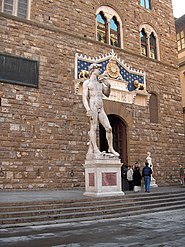
The original David outside the Palazzo Vecchio, before it was moved in 1873.

Placement [edit]
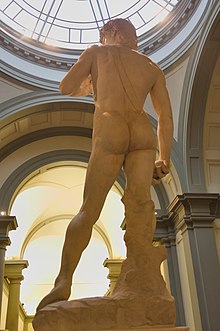
David from the back, showing the sling
On 25 January 1504, when the sculpture was nearing completion, Florentine authorities had to acknowledge there would be footling possibility of raising the more than vi-ton statue to the roof of the cathedral.[11] They convened a committee of xxx Florentine citizens that included many artists, including Leonardo da Vinci and Sandro Botticelli, to decide on an appropriate site for David.[12] While nine different locations for the statue were discussed, the majority of members seem to have been closely split up between two sites.
Ane group, led by Giuliano da Sangallo and supported by Leonardo and Piero di Cosimo, among others, believed that, due to the imperfections in the marble, the sculpture should exist placed nether the roof of the Loggia dei Lanzi on Piazza della Signoria; the other grouping thought it should stand at the entrance to the Palazzo della Signoria, the city'southward town hall (at present known as Palazzo Vecchio). Another opinion, supported by Botticelli, was that the sculpture should exist situated on or well-nigh the cathedral.
In June 1504, David was installed next to the archway to the Palazzo Vecchio, replacing Donatello's bronze sculpture of Judith and Holofernes, which embodied a comparable theme of heroic resistance. Information technology took four days to move the statue the half mile from Michelangelo's workshop into the Piazza della Signoria. Later that summer, the sling and tree-stump support were golden, and the figure was given a gilded loin-garland.[xiii] [14]
After history [edit]
In the mid 1800s, minor cracks were noticed on the left leg on David, which can possibly be attributed to an uneven sinking of the footing nether the massive statue.[15]
In 1873, the statue of David was removed from the piazza, to protect it from impairment, and displayed in the Accademia Gallery, Florence, where it attracted many visitors. A replica was placed in the Piazza della Signoria in 1910.[16]
In 1991, Piero Cannata, an artist whom the police described every bit deranged, attacked the statue with a hammer he had concealed beneath his jacket. He subsequently said that a 16th-century Venetian painter's model ordered him to practise so.[17] Cannata was restrained as he was in the process of damaging the toes of the left pes.[eighteen]
On 12 November 2010, a fiberglass replica[19] of David was installed on the roofline of Florence Cathedral, for one day only. Photographs of the installation reveal the statue the way the Operai who deputed the work originally expected information technology to be seen.
In 2010, a dispute over the buying of David arose when, based on a legal review of historical documents, the municipality of Florence claimed ownership of the statue in opposition to the Italian Civilisation Ministry building, which disputes the municipal claim.[20] [21]
Estimation [edit]
The pose of Michelangelo's David is unlike that of before Renaissance depictions of David. The bronze statues by Donatello and Verrocchio represented the hero standing victorious over the caput of Goliath, and the painter Andrea del Castagno had shown the male child in mid-swing, fifty-fifty as Goliath'south head rested between his anxiety,[22] but no earlier Florentine creative person had omitted the giant birthday. Co-ordinate to almost scholars, David is depicted before his battle with Goliath.[23] Instead of beingness shown victorious over a foe much larger than he, David looks tense and set up for battle after he has made the determination to fight Goliath, but, before the battle has really taken place. His forehead is fatigued, his cervix tense, and the veins burl out of his lowered right hand. His left mitt holds a sling that is draped over his shoulder and down to his right hand, which holds the handle of the sling.[24] The nudity reflects the story of David as stated in the Bible, I Samuel 17:38-39: "And Saul armed David with his armour, and he put an helmet of contumely upon his head; also he armed him with a coat of mail. And David girded his sword upon his armour, and he assayed to go; for he had non proved it. And David said unto Saul, I cannot go with these; for I have not proved them. And David put them off him."[25]
The twist of his body finer conveys to the viewer the feeling that he is about to motion; an impression heightened with contrapposto. The statue is a Renaissance interpretation of a common aboriginal Greek theme of the standing heroic male nude. In the High Renaissance, contrapposto poses were thought of as a distinctive characteristic of antique sculpture, initially materialised in the Doryphoros of Polykleitos (c. 440 BC). This is typified in David, as the effigy stands with one leg property its full weight and the other leg forward. This classic pose causes both hips and shoulders to residuum at opposing angles, giving a slight due south-bend to the unabridged torso. The contrapposto is emphasized by the turn of the head to the left, and by the contrasting positions of the arms.
Michelangelo'due south David has become ane of the most recognized works of Renaissance sculpture; a symbol of strength and youthful beauty. The colossal size of the statue alone impressed Michelangelo's contemporaries. Vasari described information technology as "certainly a phenomenon that of Michelangelo, to restore to life one who was expressionless," and then listed all of the largest and most g of the ancient statues that he had ever seen, final that Michelangelo's piece of work surpassed "all ancient and modern statues, whether Greek or Latin, that have ever existed."[26]
The proportions of the David are singular of Michelangelo's work; the figure has an unusually large caput and easily (particularly credible in the right hand). The small-scale size of the genitals, though, is in line with his other works and with Renaissance conventions in general, perchance referencing the ancient Greek ideal of pre-pubescent male nudity. These enlargements may be due to the fact that the statue was originally intended to be placed on the cathedral roofline, where the important parts of the sculpture may have been accentuated in order to exist visible from below. The statue is unusually slender (front to back) in comparison to its height, which may be a result of the work done on the cake earlier Michelangelo began carving it.
It is possible that the David was conceived as a political statue before Michelangelo began to piece of work on information technology.[27] Certainly, David the giant-killer had long been seen as a political effigy in Florence, and images of the Biblical hero already carried political implications at that place.[28] Donatello's bronze David, made for the Medici family unit, perchance c. 1440, had been appropriated past the Signoria in 1494, when the Medici were exiled from Florence, and the statue was installed in the courtyard of the Palazzo della Signoria, where it stood for the Republican regime of the city. Past placing Michelangelo's statue in the same full general location, the Florentine government ensured that David would be seen as a political parallel equally well equally an artistic response to that before work. These political overtones led to the statue beingness attacked twice in its early days. Protesters pelted information technology with stones the yr it debuted, and, in 1527, an anti-Medici anarchism resulted in its left arm being broken into 3 pieces.
Commentators have noted the presence of foreskin on David 's penis, which is at odds with the Judaic exercise of circumcision, but is consistent with the conventions of Renaissance art.[29] [thirty]
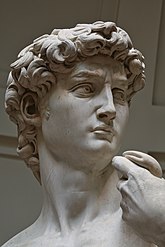
David 'southward eyes look towards Rome.
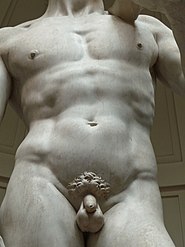
David, modelling of the marble

David 's right paw.
Conservation [edit]
During World War II, David was entombed in brick to protect it from damage from airborne bombs.

Detail of David 's damaged left pes, caused by exposure to the elements and in 1991 when a man hit information technology with a curtained hammer.
In 1991, the foot of the statue was damaged by a man with a hammer.[17] The samples obtained from that incident immune scientists to make up one's mind that the marble used was obtained from the Fantiscritti quarries in Miseglia, the cardinal of three small valleys in Carrara. The marble in question contains many microscopic holes that crusade it to deteriorate faster than other marbles. Because of the marble'south deposition, from 2003 to 2004 the statue was given its start major cleaning since 1843. Some experts opposed the use of h2o to make clean the statue, fearing further deterioration. Nether the direction of Franca Falleti, senior restorers Monica Eichmann and Cinzia Parnigoni undertook the task of restoring the statue.[31]
In 2008, plans were proposed to insulate the statue from the vibration of tourists' footsteps at Florence'south Galleria dell'Accademia, to foreclose damage to the marble.[32]
Replicas [edit]
David has stood on display at Florence'south Galleria dell'Accademia since 1873. In addition to the total-sized replica occupying the spot of the original in front of the Palazzo Vecchio, a statuary version overlooks Florence from the Piazzale Michelangelo. The plaster cast of David at the Victoria and Albert Museum has a detachable plaster fig leaf which is displayed nearby. Fable claims that the fig leaf was created in response to Queen Victoria's shock upon kickoff viewing the statue'due south nudity, and was hung on the figure prior to imperial visits, using ii strategically placed hooks.[33]
David has often been reproduced,[34] in plaster and imitation marble fibreglass, signifying an attempt to lend an temper of culture even in some unlikely settings such as beach resorts, gambling casinos and model railroads.[35]
Come across also [edit]
- List of works by Michelangelo
- List of tallest statues
Notes [edit]
- ^ The height of the David was recorded incorrectly and the mistake proliferated through many art history publications. The accurate height was only adamant in 1998–99 when a team from Stanford University went to Florence to try out a project on digitally imaging large 3D objects by photographing sculptures by Michelangelo and found that the sculpture was taller than any of the sources had indicated.[i] [two]
- ^ Encounter, for example, Donatello'due south two versions of David; Verrocchio's bronze David; Domenico Ghirlandaio's painting of David; and Bartolomeo Bellano's bronze David.
Citations [edit]
- ^ See
- ^ "Frequently asked questions (FAQ)".
- ^ This theory was first proposed[ citation needed ] by Saul Levine "The Location of Michelangelo's David: The Meeting of January 25, 1504, The Art Message 56 (1974): 31–49.
- ^ The genesis of David was discussed in Seymour 1967 and in Coonin 2014.
- ^ Charles Seymour, Jr. "Homo Magnus et Albus: the Quattrocento Background for Michelangelo'due south David of 1501–04," Stil und Überlieferung in der Kunst des Abendlandes, Berlin, 1967, Two, 96–105.
- ^ Seymour, 100–101.
- ^ a b Gaetano Milanesi, Le lettere di Michelangelo Buonarroti pubblicati coi ricordi ed i contratti artistici, Florence, 1875, 620–623: "...the Consuls of the Arte della Lana and the Lords Overseers being met Overseers, take chosen every bit sculptor to the said Cathedral the worthy principal, Michelangelo, the son of Lodovico Buonarrotti, a citizen of Florence, to the end that he may brand, stop and bring to perfection the male figure known as the Giant, ix braccia in height, already blocked out in marble by Maestro Agostino grande, of Florence, and badly blocked; and now stored in the workshops of the Cathedral. The work shall exist completed within the period and term of two years next ensuing, beginning from the first day of September next ensuing, with a salary and payment together in articulation assembly within the hall of the said of vi broad florins of gilded in gold for every month. And for all other works that shall be required about the said edifice (edificium) the said Overseers demark themselves to supply and provide both men and scaffolding from their role and all else that may be necessary. When the said piece of work and the said male figure of marble shall exist finished, then the Consuls and Overseers who shall at that time be in authority shall guess whether it merits a higher reward, being guided therein past the dictates of their own consciences."
- ^ Giovanni Gaye, Carteggio inedito d'artisti del sec. 14, Xv, 16, Florence: 1839–40, two: 454 and Charles Seymour, Michelangelo's David: A Search for Identity, Pittsburgh: Pittsburgh Academy Press, 1967, 134–137, doctor. 34.
- ^ De la Croix, Horst; Tansey, Richard G.; Kirkpatrick, Diane (1991). Gardner'southward Art Through the Ages (ninth ed.). Thomson/Wadsworth. p. 651. ISBN0-15-503769-two.
- ^ Coughlan, Robert (1966). The World of Michelangelo: 1475–1564. et al. Time-Life Books. p. 85.
- ^ The statue has not been weighed, only an estimate of its weight was circulated in 2004, when the statue was cleaned. See a CBS news report of 8 March 2004.
- ^ The minutes of the coming together were published in Giovanni Gaye, Carteggio inedito d'artisti del sec. XIV, XV, XVI, Florence, 1839–forty, two: 454–463. For an English translation of the document, see Seymour, Michelangelo'southward David, 140–155 and for an analysis, run into Saul Levine, "The Location of Michelangelo's David: The Meeting of January 25, 1504, Fine art Bulletin 56 (1974): 31–49; N. Randolph Parks, "The Placement of Michelangelo'south David: A Review of the Documents," Art Bulletin, 57 (1975) 560–570; and Rona Goffen, Renaissance Rivals: Michelangelo, Leonardo, Raphael, Titian, New Haven, 2002, 123–127.
- ^ Goffen (2002), p. 130.
- ^ Coonin, 2014, pp. 90–94.
- ^ A., Borri (2006). "Diagnostic analysis of the lesions and stability of Michelangelo's David". Periodical of Cultural Heritage. 7 (four): 273–285. doi:x.1016/j.culher.2006.06.004.
- ^ Coonin, 2014.
- ^ a b "a man the police force described as deranged, bankrupt role of a toe with a hammer, saying a 16th century Venetian painter's model ordered him to do and so." Cowell, Alan. "Michelangelo'southward David Is Damaged", New York Times, 1991-09-xv. Retrieved on 2008-05-23.
- ^ Rossella Lorenzi, Art lovers go nuts over dishy David, ABC Science, Monday, 21 November 2005
- ^ "Michelangelo's David as It Was Meant to Be Seen : Discovery News". news.discovery.com. Archived from the original on 25 May 2016. Retrieved 24 July 2014.
- ^ Povoledo, Elisabetta (31 August 2010). "Who Owns Michelangelo's 'David'?". The New York Times . Retrieved 1 September 2010.
- ^ Pisa, Nick (sixteen August 2010). "Florence vs Italy: Michelangelo's David at centre of ownership row". The Daily Telegraph (London). Archived from the original on 2022-01-11. Retrieved one September 2010.
- ^ "File:Andrea del castagno, scudo di david con la testa di golia, 1450-55 circa, 02.JPG – Wikimedia Commons". commons.wikimedia.org. Retrieved 24 July 2014.
- ^ Howard Hibbard, Michelangelo, New York: Harper & Row, 1974, 59–61; Anthony Hughes, Michelangelo, London: Phaidon, 1997, 74.
- ^ "David Sculpture, Michelango's David, Michelangelo Gallery".
- ^ "1 SAMUEL CHAPTER 17 KJV". www.kingjamesbibleonline.org . Retrieved 2021-04-03 .
- ^ Giorgio Vasari, Le vite de' più eccellenti pittori, scultori east architettori nelle redazioni del 1550 e 1568, ed. Rosanna Bettarini and Paola Barocchi, Florence, 1966–87, 6: 21.
- ^ Levine, 45–46.
- ^ Butterfield, Andrew (1995). "New Evidence for the Iconography of David in Quattrocento Florence". I Tatti Studies. viii: 115–133.
- ^ Strauss, RM; Marzo-Ortega, H (2002). "Michelangelo and medicine". J R Soc Med. 95 (10): 514–five. doi:ten.1258/jrsm.95.10.514. PMC1279184. PMID 12356979.
- ^ Coonin, 2014, pp. 105-108.
- ^ Eric Scigliano. "Inglorious Restorations. Destroying Old Masterpieces in Gild to Save Them." Harper's Mag. Baronial 2005, 61–68.
- ^ "Michelangelo's David 'may fissure'". BBC News. nineteen September 2008. Retrieved 19 September 2008.
- ^ "David's Fig Leaf". Victoria and Albert Museum. Retrieved 29 May 2007.
- ^ " Yous need non travel to Florence to encounter Michelangelo'southward David. You can see it well enough for educational purposes in reproduction," asserted E. B. Feldman in 1973 (Feldman, "The instructor equally model critic", Periodical of Aesthetic Pedagogy, 1973).
- ^ That "typical examples of kitsch include refrigerator magnets showing Michelangelo's David." is reported fifty-fifty in the British Medical Journal (J Launer, "Medical kitsch", BMJ, 2000)
Bibliography [edit]
| External video | |
|---|---|
 | |
 Michelangelo's David, Smarthistory Michelangelo's David, Smarthistory |
- Coonin, A. Victor, From Marble to Flesh: The Biography of Michelangelo's David, Florence: The Florentine Press, 2014. ISBN 9788897696025.
- Goffen, Rona (2002). Renaissance Rivals: Michelangelo, Leonardo, Raphael, Titian. Yale University Press.
- Hall, James, Michelangelo and the Reinvention of the Human Body New York: Farrar, Straus and Giroux, 2005.
- Hartt, Frederick, Michelangelo: the complete sculpture, New York: Abrams Books,1982.
- Hibbard, Howard. Michelangelo, New York: Harper & Row, 1974.
- Hirst Michael, "Michelangelo In Florence: David In 1503 and Hercules In 1506," The Burlington Magazine, 142 (2000): 487–492.
- Hughes, Anthony, Michelangelo, London: Phaidon Press, 1997.
- Levine, Saul, "The Location of Michelangelo's David: The Meeting of January 25, 1504", The Fine art Bulletin, 56 (1974): 31–49.
- Natali, Antonio; Michelangelo (2014). Michelangelo Within and Outside the Uffizi. Florence: Maschietto. ISBN978-88-6394-085-5.
- Pope-Hennessy, John, Italian High Renaissance and Baroque Sculpture. London: Phaidon, 1996.
- Seymour, Charles, Jr. Michelangelo'south David: a search for identity (Mellon Studies in the Humanities), Pittsburgh: University of Pittsburgh Press, 1967.
- Vasari, Giorgio, The Lives of the Artists (Penguin Books), "Life of Michelangelo", pp. 325–442.
External links [edit]
- x Facts That You Don't Know Almost Michelangelo's David
- Michelangelo Buonarroti: David, Fine art and the Bible
- The Digital Michelangelo Project, Stanford Academy
- Models of wax and clay used by Michelangelo in making his sculpture and paintings
- The Museums of Florence – The David of Michelangelo
Coordinates: 43°46′36.13″N 11°xv′34.02″E / 43.7767028°Due north eleven.2594500°E / 43.7767028; eleven.2594500
Source: https://en.wikipedia.org/wiki/David_(Michelangelo)
0 Response to "Where Can You See the Statue of David?"
Post a Comment