The Invention of Race in the European Middle Ages Review
The concept of race as a superficial division of anatomically modern humans (Homo sapiens) has an extensive history in Europe and the Americas. The contemporary discussion race itself is modernistic, historically it was used in the sense of "nation, ethnic group" during the 16th to 19th centuries.[ane] [2] Race acquired its modern meaning in the field of concrete anthropology through scientific racism starting in the 19th century. With the rise of modern genetics, the concept of singled-out human races in a biological sense has become obsolete. In 2019, the American Association of Biological Anthropologists stated: "The belief in 'races' every bit natural aspects of human biology, and the structures of inequality (racism) that sally from such beliefs, are among the most damaging elements in the man experience both today and in the past."[3]
Etymology [edit]
The word "race", interpreted to mean an identifiable grouping of people who share a common descent, was introduced into English in most 1580, from the Quondam French rasse (1512), from Italian razza . An earlier but etymologically distinct word for a like concept was the Latin word genus meaning a group sharing qualities related to nativity, descent, origin, race, stock, or family unit; this Latin word is cognate with the Greek words "genos", ( γένος ) meaning "race or kind", and "gonos", which has meanings related to "nativity, offspring, stock ...".[4]
Early on history [edit]
In many ancient civilizations, individuals with widely varying concrete appearances became full members of a society by growing up within that society or by adopting that guild's cultural norms. (Snowden 1983; Lewis 1990)[ pages needed ]
Classical civilizations from Rome to Red china tended to invest the nigh importance in familial or tribal amalgamation rather than an private'south concrete appearance (Dikötter 1992; Goldenberg 2003). Societies nonetheless tended to equate concrete characteristics, such as hair and middle color, with psychological and moral qualities, normally assigning the highest qualities to their own people and lower qualities to the "Other", either lower classes or outsiders to their society. For example, a historian of the 3rd century Han Dynasty in the territory of nowadays-day Mainland china describes barbarians of blond hair and green eyes as resembling "the monkeys from which they are descended".[5] (Gossett, pp. 4)
Dominant in aboriginal Greek and Roman conceptions of human diversity was the thesis that concrete differences between unlike populations could be attributed to environmental factors. Though ancient peoples likely had no knowledge of evolutionary theory or genetic variability, their concepts of race could be described equally malleable. Chief among environmental causes for physical difference in the ancient period were climate and geography. Though thinkers in ancient civilizations recognized differences in concrete characteristics between dissimilar populations, the general consensus was that all non-Greeks were barbarians. This barbarian condition, however, was not idea to be fixed; rather, ane could shed the 'barbarian' status simply past adopting Greek culture.[6] (Graves 2001)[ page needed ]
Classical antiquity [edit]

Hippocrates of Kos believed, as many thinkers throughout early on history did, that factors such equally geography and climate played a meaning role in the physical appearance of different peoples. He writes, "the forms and dispositions of mankind represent with the nature of the country". He attributed physical and temperamental differences amongst dissimilar peoples to environmental factors such equally climate, water sources, elevation and terrain. He noted that temperate climates created peoples who were "sluggish" and "non apt for labor", while extreme climates led to peoples who were "sharp", "industrious" and "vigilant". He also noted that peoples of "mountainous, rugged, elevated, and well-watered" countries displayed "enterprising" and "warlike" characteristics, while peoples of "level, windy, and well-watered" countries were "unmanly" and "gentle".[7]
The Roman emperor Julian factored in the constitutions, laws, capacities, and graphic symbol of peoples:
"Come up, tell me why information technology is that the Celts and the Germans are fierce, while the Hellenes and Romans are, generally speaking, inclined to political life and humane, though at the same time unyielding and warlike? Why the Egyptians are more than intelligent and more given to crafts, and the Syrians unwarlike and effeminate, but at the same time intelligent, hot-tempered, vain and quick to learn? For if there is anyone who does non discern a reason for these differences among the nations, merely rather declaims that all this so befell spontaneously, how, I ask, can he notwithstanding believe that the universe is administered past a providence?"[8]
Middle Ages [edit]
European medieval models of race generally mixed Classical ideas with the notion that humanity every bit a whole was descended from Shem, Ham and Japheth, the three sons of Noah, producing distinct Semitic (Asiatic), Hamitic (African), and Japhetic (Indo-European) peoples. The association between the sons of Noah and pare color dates dorsum at least to the Babylonian Talmud, which states that the descendants of Ham were cursed with black skin.[9] In the seventh century, the thought that black Africans were cursed with both night skin and slavery began to gain strength with some Islamic writers, every bit black Africans became a slave class in the Islamic world.[9]
In the 9th century, Al-Jahiz, an Afro-Arab Islamic philosopher, attempted to explain the origins of different human being skin colors, specially black pare, which he believed to be the upshot of the environment. He cited a stony region of black basalt in the northern Najd as evidence for his theory.[10]
In the 14th century, the Islamic sociologist Ibn Khaldun, dispelled the Babylonian Talmud's account of peoples and their characteristics every bit a myth. He wrote that black skin was due to the hot climate of sub-Saharan Africa and not due to the descendants of Ham being cursed.[11]
Independently of Ibn Khaldun's piece of work, the question of whether peel color is heritable or a product of the environment is raised in 17th to 18th century European anthropology. Georgius Hornius (1666) inherits the rabbinical view of heritability, while François Bernier (1684) argues for at least partial influence of the environment. Ibn Khaldun's work was later[ year needed ] translated into French, especially for use in Algeria, but in the process, the piece of work was "transformed from local cognition to colonial categories of knowledge"[ clarification needed ].[12] William Desborough Cooley's The Negro Land of the Arabs Examined and Explained (1841) has excerpts of translations of Khaldun'due south piece of work that were not affected past French colonial ideas.[13] For example, Cooley quotes Khaldun'southward describing the cracking African civilization of Ghana (in Cooley's translation):
- "When the conquest of the West (by the Arabs) was completed, and merchants began to penetrate into the interior, they saw no nation of the Blacks so mighty equally Ghánah, the dominions of which extended westward as far as the Body of water. The Male monarch's court was kept in the city of Ghánah, which, according to the author of the 'Volume of Roger' (El Idrisi), and the author of the 'Volume of Roads and Realms' (El Bekri), is divided into two parts, standing on both banks of the Nile, and ranks among the largest and most populous cities of the world.
- The people of Ghánah had for neighbours, on the east, a nation, which, according to historians, was called Súsú; after which came another named Máli; and later that another known by the proper noun of Kaǘkaǘ; although some people adopt a unlike orthography, and write this name Kághó. The final-named nation was followed by a people chosen Tekrúr. The people of Ghánah declined in form of time, being overwhelmed or captivated by the Molaththemún (or muffled people; that is, the Morabites), who, adjoining them on the north towards the Berber country, attacked them, and, taking possession of their territory, compelled them to embrace the Mohammedan organized religion. The people of Ghánah, being invaded at a later period by the Súsú, a nation of Blacks in their neighbourhood, were exterminated, or mixed with other Black nations."[13]
Ibn Khaldun suggests a link betwixt the rise of the Almoravids and the decline of Republic of ghana. However, historians take found well-nigh no evidence for an Almoravid conquest of Ghana.[14] [15]
Early on modern period [edit]
Scientists who were interested in natural history, including biological and geological scientists, were known as "naturalists". They would collect, examine, draw, and arrange data from their explorations into categories according to certain criteria. People who were especially skilled at organizing specific sets of information in a logically and comprehensive fashion were known as classifiers and systematists. This process was a new trend in science that served to help answer fundamental questions by collecting and organizing materials for systematic report, also known every bit taxonomy.[sixteen]
As the study of natural history grew, so did scientists' endeavor to allocate homo groups. Some zoologists and scientists wondered what made humans dissimilar from animals in the primate family. Furthermore, they contemplated whether homo sapiens should be classified as one species with multiple varieties or separate species. In the 16th and 17th century, scientists attempted to classify Human being sapiens based on a geographic arrangement of man populations based on peel color, others merely on geographic location, shape, stature, food habits, and other distinguishing characteristics. Occasionally the term "race" was used, but nearly of the early on taxonomists used classificatory terms, such as "peoples", "nations", "types", "varieties", and "species".
Italian philosopher Giordano Bruno (1548–1600) and Jean Bodin (1530–1596), French philosopher, attempted a rudimentary geographic organization of known human populations based on skin color. Bodin's color classifications were purely descriptive, including neutral terms such as "duskish colour, similar roasted quinze", "black", "anecdote", and "farish white".[16]
17th century [edit]
German and English scientists, Bernhard Varen (1622–1650) and John Ray (1627–1705) classified human populations into categories co-ordinate to stature, shape, nutrient habits, and skin colour, along with whatsoever other distinguishing characteristics.[16] Ray was also the starting time person to produce a biological definition of species.
François Bernier (1625–1688) is believed to have developed the first comprehensive classification of humans into distinct races which was published in a French journal article in 1684, Nouvelle division de la terre par les différentes espèces ou races l'habitant, New partitioning of Earth by the different species or races which inhabit it. (Gossett, 1997:32–33). Bernier advocated using the "4 quarters" of the globe as the basis for providing labels for human differences.[16] The iv subgroups that Bernier used were Europeans, Far Easterners, Negroes (blacks), and Lapps.[17]
18th century [edit]
As noted earlier, scientists attempted to classify Homo sapiens based on a geographic arrangement of human populations. Some based their hypothetical divisions of race on the most obvious physical differences, like pare color, while others used geographic location, shape, stature, food habits, and other distinguishing characteristics to delineate betwixt races. However, cultural notions of racial and gender superiority tainted early scientific discovery. In the 18th century, scientists began to include behavioral or psychological traits in their reported observations—which traits oftentimes had derogatory or demeaning implications—and researchers often causeless that those traits were related to their race, and therefore, innate and unchangeable. Other areas of interest were to determine the exact number of races, categorize and proper noun them, and examine the primary and secondary causes of variation betwixt groups.
The Great Chain of Being, a medieval idea that there was a hierarchical structure of life from the almost fundamental elements to the most perfect, began to encroach upon the idea of race. As taxonomy grew, scientists began to presume that the human species could be divided into distinct subgroups. 1'south "race" necessarily implied that one group had certain character qualities and physical dispositions that differentiated it from other man populations. Society[ who? ] assigned unlike values to those differentiations, too as other, more trivial traits (a man with a strong chin was assumed to possess a stronger grapheme than men with weaker chins). This essentially created a gap between races past deeming 1 race superior or inferior to another race, thus creating a hierarchy of races. In this way, science was used as justification for unfair handling of different man populations.
The systematization of race concepts during the Enlightenment menstruation brought with it the disharmonize between monogenism (a single origin for all human races) and polygenism (the hypothesis that races had dissever origins). This fence was originally cast in creationist terms equally a question of i versus many creations of humanity, but connected afterwards evolution was widely accustomed, at which signal the question was given in terms of whether humans had split from their ancestral species one or many times.
Johann Friedrich Blumenbach [edit]
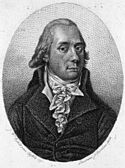
Johann Friedrich Blumenbach
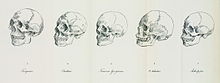
Johann Friedrich Blumenbach (1752–1840) divided the human being species into v races in 1779, later founded on crania research (description of human skulls), and called them (1793/1795):[18] [19]
- the Caucasian race (Europe, the Caucasus, Asia Small-scale, Northward Africa and Due west Asia)
- the Mongolian race (East Asia, Central Asia and South Asia)
- the Aethiopian race (Sub-Saharan Africa)
- the American race (Due north America and Due south America)
- the Malayan race (Southeast Asia)
Blumenbach argued that physical characteristics like the collective characteristic types of facial structure and hair characteristics, peel color, cranial profile, etc., depended on geography and diet and custom. Blumenbach'due south work included his description of sixty human being crania (skulls) published originally in fascicules every bit Decas craniorum (Göttingen, 1790–1828). This was a founding piece of work for other scientists in the field of craniometry.
Further anatomical written report led him to the determination that 'individual Africans differ as much, or fifty-fifty more, from other private Africans as Europeans differ from Europeans'. Furthermore, he concluded that Africans were not inferior to the rest of mankind 'concerning good for you faculties of understanding, excellent natural talents and mental capacities'.[twenty]
"Finally, I am of opinion that after all these numerous instances I have brought together of negroes of capacity, it would not exist difficult to mention entire well-known provinces of Europe, from out of which you would non easily expect to obtain off-mitt such good authors, poets, philosophers, and correspondents of the Paris Academy; and on the other hand, there is no so-called savage nation known under the sun which has so much distinguished itself by such examples of perfectibility and original capacity for scientific culture, and thereby fastened itself so closely to the about civilized nations of the earth, as the Negro."[21]
These 5 groups saw some continuity in the various nomenclature schemes of the 19th century, in some cases augmented, east.k. by the Australoid race[22] and the Capoid race in some cases the Mongolian (East Asian) and American complanate into a single grouping.
Racial anthropology (1850–1930) [edit]

Engraving depicting what was considered "The Types of Races of Men" past the author.
Among the 19th century naturalists who defined the field were Georges Cuvier, James Cowles Pritchard, Louis Agassiz, Charles Pickering (Races of Man and Their Geographical Distribution, 1848). Cuvier enumerated iii races, Pritchard seven, Agassiz twelve, and Pickering eleven.
The 19th century saw the introduction of anthropological techniques such every bit anthropometrics, invented past Francis Galton and Alphonse Bertillon. They measured the shapes and sizes of skulls and related the results to group differences in intelligence or other attributes.[23]
Stefan Kuhl wrote that the eugenics motility rejected the racial and national hypotheses of Arthur Gobineau and his writing An Essay on the Inequality of the Human Races. According to Kuhl, the eugenicists believed that nations were political and cultural constructs, not race constructs, because nations were the result of race mixtures.[24] Georges Vacher de Lapouge'due south "anthroposociology", asserted as cocky-evident the biological inferiority of particular groups (Kevles 1985). In many parts of the globe, the thought of race became a way of rigidly dividing groups by culture as well every bit by concrete appearances (Hannaford 1996). Campaigns of oppression and genocide were oft motivated by supposed racial differences (Horowitz 2001[ commendation needed ]).
During the late 19th century and early 20th century, the tension between some who believed in hierarchy and innate superiority, and others who believed in human being equality, was at a paramount. The former connected to exacerbate the belief that certain races were innately inferior by examining their shortcomings, namely by examining and testing intelligence between groups. Some scientists claimed that there was a biological determinant of race by evaluating 1's genes and Deoxyribonucleic acid. Different methods of eugenics, the study and practice of man selective breeding oft with a race every bit a principal concentration, was withal widely accepted in Uk, Germany, and the Us.[25] On the other hand, many scientists understood race every bit a social construct. They believed that the phenotypical expression of an private were adamant by one'south genes that are inherited through reproduction simply at that place were sure social constructs, such equally culture, surround, and language that were primary in shaping behavioral characteristics. Some advocated that race 'should centre not on what race explains about society, simply rather on the questions of who, why and with what outcome social significance is attached to racial attributes that are synthetic in particular political and socio-economic contexts', and thus, addressing the "folk" or "mythological representations" of race.[26]
Louis Agassiz's racial definitions [edit]
After Louis Agassiz (1807–1873) traveled to the United States, he became a prolific author in what has been later termed the genre of scientific racism. Agassiz was specifically a believer and abet in polygenism, that races came from separate origins (specifically dissever creations), were endowed with unequal attributes, and could be classified into specific climatic zones, in the same way he felt other animals and plants could be classified.
These included Western American Temperate (the indigenous peoples westward of the Rockies); Eastern American Temperate (e of the Rockies); Tropical Asiatic (south of the Himalayas); Temperate Asiatic (due east of the Urals and due north of the Himalayas); Due south American Temperate (South America); New Holland (Australia); Arctic (Alaska and Arctic Canada); Cape of Good Hope (Southward Africa); and American Tropical (Central America and the West Indies).
Agassiz denied that species originated in single pairs, whether at a unmarried location or at many. He argued instead multiple individuals in each species were created at the same fourth dimension and and then distributed throughout the continents where God meant for them to dwell. His lectures on polygenism were popular amongst the slaveholders in the Southward, for many this stance legitimized the belief in a lower standard of the Negro.
His stance in this case was considered to be quite radical in its time, because it went against the more than orthodox and standard reading of the Bible in his time which unsaid all homo stock descended from a single couple (Adam and Eve), and in his defence Agassiz ofttimes used what now sounds like a very "modern" argument about the need for independence between science and faith; though Agassiz, different many polygeneticists, maintained his religious beliefs and was non anti-Biblical in general.
In the context of ethnology and anthropology of the mid-19th century, Agassiz's polygenetic views became explicitly seen as opposing Darwin'southward views on race, which sought to show the mutual origin of all human races and the superficiality of racial differences. Darwin'due south second book on evolution, The Descent of Man, features extensive argumentation addressing the single origin of the races, at times explicitly opposing Agassiz's theories.
Arthur de Gobineau [edit]
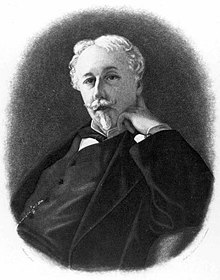
Arthur de Gobineau (1816–1882) was a successful diplomat for the Second French Empire. Initially he was posted to Persia, before working in Brazil and other countries. He came to believe that race created culture, arguing that distinctions between the 3 "black", "white", and "yellow" races were natural barriers, and that "race-mixing" breaks those barriers down and leads to chaos. He classified the populations of the Middle East, Primal Asia, the Indian subcontinent, North Africa, and southern French republic as being racially mixed.
Gobineau also believed that the white race was superior to all others. He idea it corresponded to the aboriginal Indo-European culture, too known as "Aryan". Gobineau originally wrote that the white race's miscegenation was inevitable. He attributed much of the economical turmoils in France to the pollution of races. After in his life, he contradistinct his opinion to believe that the white race could exist saved.
To Gobineau, the development of empires was ultimately destructive to the "superior races" that created them, since they led to the mixing of distinct races. This he saw equally a degenerative process.
According to his definitions, the people of Espana, most of France, most of Germany, southern and western Iran as well equally Switzerland, Austria, Northern Italia, and a large part of Britain, consisted of a degenerative race that arose from miscegenation. Also co-ordinate to him, the whole population of North India consisted of a yellow race.
Thomas Huxley'due south racial definitions [edit]

Huxley'south map of racial categories from On the Geographical Distribution of the Chief Modifications of Mankind (1870).
Huxley states: 'Information technology is to the Xanthochroi and Melanochroi, taken together, that the absurd denomination of "Caucasian" is usually applied'.[27] He also indicates that he has omitted certain areas with complex indigenous compositions that do not fit into his racial paradigm, including much of the Horn of Africa and the Indian subcontinent.[28] Huxley's Melanochroi somewhen comprised diverse other dark Caucasoid populations, including the Hamites and Moors.[29]
Thomas Huxley (1825–1895) wrote one newspaper, "On the Geographical Distribution of the Chief Modifications of Mankind" (1870), in which he proposed a distinction within the human species ('races'), and their distribution beyond the earth. He also acknowledged that certain geographical areas with more complex ethnic compositions, including much of the Horn of Africa and the Bharat subcontinent, did not fit into his racial paradigm. Every bit such, he noted that: "I have purposely omitted such people every bit the Abyssinians and the Hindoos, who in that location is every reason to believe outcome from the intermixture of distinct stocks."[28] By the late nineteenth century, Huxley's Xanthochroi group had been redefined as the Nordic race, whereas his Melanochroi became the Mediterranean race. His Melanochroi thus somewhen likewise comprised various other nighttime Caucasoid populations, including the Hamites (due east.yard. Berbers, Somalis, northern Sudanese, ancient Egyptians) and Moors.[29]
Huxley's paper was rejected by the Royal Society, and this became one of the many theories to be avant-garde and dropped past the early exponents of evolution.
Despite rejection by Huxley and the science community, the paper is sometimes cited in back up of racialism.[30] Along with Darwin, Huxley was a monogenist, the conventionalities that all humans are part of the same species, with morphological variations emerging out of an initial uniformity. (Stepan, p. 44). This view contrasts polygenism, the theory that each race is actually a dissever species with separate sites of origin.
Despite Huxley's monogenism and his abolition on upstanding grounds, Huxley assumed a bureaucracy of innate abilities, a stance evinced in papers such as "Emancipation Black and White" and his almost famous newspaper, "Evolution and Ideals".
In the former, he writes that the "highest places in the bureaucracy of civilization will assuredly not be inside the reach of our dusky cousins, though it is past no means necessary that they should exist restricted to the lowest". (Stepan, p. 79–80).
Charles Darwin and race [edit]
Though Charles Darwin'due south evolutionary theory was ready forth in 1859 upon publication of On the Origin of Species, this work was largely absent of explicit reference to Darwin'due south theory practical to man. This application past Darwin would not become explicit until 1871 with the publication of his second corking book on evolution, The Descent of Man, and Selection in Relation to Sex activity.
Darwin'south publication of this book occurred within the heated debates between advocates of monogeny, who held that all races came from a common ancestor, and advocates of polygeny, who held that the races were separately created. Darwin, who had come from a family with stiff abolitionist ties, had experienced and was disturbed by cultures of slavery during his voyage on the Beagle years earlier. Noted Darwin biographers Adrian Desmond and James Moore argue that Darwin's writings on development were not only influenced by his abolitionist tendencies, but likewise his belief that non-white races were equal in regard to their intellectual capacity as white races, a belief which had been strongly disputed past scientists such equally Morton, Agassiz and Broca, all noted polygenists.
By the late 1860s, however, Darwin's theory of evolution had been thought to be compatible with the polygenist thesis (Stepan 1982). Darwin thus used Descent of Man to disprove the polygenist thesis and stop the contend between polygeny and monogeny in one case and for all. Darwin also used it to disprove other hypotheses about racial difference that had persisted since the fourth dimension of ancient Hellenic republic, for example, that differences in peel color and body constitution occurred because of differences of geography and climate.
Darwin ended, for case, that the biological similarities between the unlike races were "too neat" for the polygenist thesis to be plausible. He too used the idea of races to argue for the continuity between humans and animals, noting that it would be highly implausible that man should, by mere blow learn characteristics shared by many apes.
Darwin sought to demonstrate that the concrete characteristics that were being used to define race for centuries (i.e. skin color and facial features) were superficial and had no utility for survival. Because, according to Darwin, any characteristic that did not have survival value could not have been naturally selected, he devised another hypothesis for the development and persistence of these characteristics. The mechanism Darwin developed is known as sexual selection.
Though the idea of sexual option had appeared in earlier works by Darwin, it was not until the tardily 1860s when it received total consideration (Stepan 1982). Furthermore, it was not until 1914 that sexual pick received serious consideration every bit a racial theory by naturalist thinkers.
Darwin defined sexual choice as the "struggle between individuals of 1 sex, more often than not the males, for the possession of the other sex". Sexual option consisted of two types for Darwin: 1.) The concrete struggle for a mate, and ii.) The preference for some color or another, typically by females of a given species. Darwin asserted that the differing human being races (insofar as race was conceived phenotypically) had arbitrary standards of ideal beauty, and that these standards reflected important physical characteristics sought in mates.
Broadly speaking, Darwin's attitudes of what race was and how it developed in the human species are attributable to two assertions, ane.) That all human being beings, regardless of race, share a single, common ancestor, and 2.) Phenotypic racial differences are superficially selected, and take no survival value.[ commendation needed ] Given these two behavior, some believe Darwin to have established monogenism every bit the dominant paradigm for racial beginnings, and to have defeated the scientific racism practiced by Morton, Knott, Agassiz et. Al, as well equally notions that there existed a natural racial hierarchy that reflected inborn differences and measures of value between the dissimilar human races. Still, he stated: "The diverse races, when carefully compared and measured, differ much from each other – every bit in the texture of pilus, the relative proportions of all parts of the body, the capacity of the lungs, the form and capacity of the skull, and fifty-fifty the convolutions of the brain. But it would be an countless task to specify the numerous points of divergence. The races differ also in constitution, in acclimatization and in liability to certain diseases. Their mental characteristics are too very distinct; chiefly every bit information technology would appear in their emotion, only partly in their intellectual faculties." (The Descent of Homo, chapter 7).
In The Descent of Homo, Darwin noted the dandy difficulty naturalists had in trying to determine how many "races" there actually were:
Human has been studied more than carefully than whatsoever other animal, and yet in that location is the greatest possible diversity amongst capable judges whether he should be classed equally a single species or race, or as two (Virey), equally 3 (Jacquinot), as iv (Kant), five (Blumenbach), six (Buffon), seven (Hunter), eight (Agassiz), eleven (Pickering), fifteen (Bory St. Vincent), 16 (Desmoulins), xx-2 (Morton), sixty (Crawfurd), or as threescore-three, according to Burke. This diversity of judgment does non prove that the races ought non to be ranked equally species, simply it shews that they graduate into each other, and that it is hardly possible to detect articulate distinctive characters between them.
Decline of racial studies after 1930 [edit]
Several social and political developments that occurred at the terminate of the 19th century and into the 20th century led to the transformation in the soapbox of race. 3 movements that historians accept considered are: the coming of mass democracy, the age of imperialist expansion, and the affect of Nazism.[31] More than any other, the violence of Nazi dominion, the Holocaust, and World State of war II transformed the whole discussion of race. Nazism made an argument for racial superiority based on a biological footing. This led to the idea that people could be divided into discrete groups and based on the divisions, at that place would be astringent, tortuous, and oftentimes fatal event. The exposition of Nazi racial theories, which culminated in the Final Solution, created a moral revolution against racism.[31] In 1950, and as a response to the genocide of Nazism, UNESCO was formed and released a argument proverb that there was no biological determinant or basis for race.
Consequently, studies of homo variation focused more on actual patterns of variation and evolutionary patterns among populations and less about classification. Some scientists point to iii discoveries. Firstly, African populations exhibit greater genetic multifariousness and less linkage disequilibrium because of their long history. Secondly, genetic similarity is direct correlated with geographic proximity. Lastly, some loci reflect choice in response to environmental gradients. Therefore, some debate, human racial groups practise not appear to be distinct indigenous groups.[32]
Franz Boas [edit]
Franz Boas (1858–1942) was a German language American anthropologist and has been chosen the "Father of American Anthropology". Professor of anthropology at Columbia Academy from 1899, Boas made significant contributions within anthropology, more than specifically, physical anthropology, linguistics, archeology, and cultural anthropology. His piece of work put an accent on cultural and environmental effects on people to explain their development into adulthood and evaluated them in concert with human being biology and evolution. This encouraged academics to break away from static taxonomical classifications of race. It is said that earlier Boas, anthropology was the study of race, and subsequently Boas, anthropology was the report of culture.
The 20th-century criticism of racial anthropology was significantly based on Boas and his school. Beginning in 1920, he strongly favoured the influence of social surroundings over heritability. As a reaction to the ascent of Nazi Germany and its prominent espousing of racist ideologies in the 1930s, there was an outpouring of pop works past scientists criticizing the employ of race to justify the politics of "superiority" and "inferiority". An influential work in this regard was the publication of Nosotros Europeans: A Survey of "Racial" Problems by Julian Huxley and A. C. Haddon in 1935, which sought to prove that population genetics immune for merely a highly limited definition of race at best. Some other pop work during this period, "The Races of Mankind" by Ruth Benedict and Cistron Weltfish, argued that though there were some extreme racial differences, they were primarily superficial, and in any case did not justify political activeness.
Julian Huxley and A. C. Haddon [edit]
Sir Julian Sorell Huxley (1887–1975) was an English language evolutionary biologist, humanist, internationalist, and the first managing director of UNESCO. Later returning to England from a bout of the United States in 1924, Huxley wrote a series of articles for the Spectator which he expressed his belief in the drastic differences betwixt "negros" and "whites".[33] He believed that the colour of "blood" – percentage of 'white' and 'blackness' blood – that a person had would make up one's mind a person'due south mental capacity, moral probity, and social behavior. "Blood" also determined how individuals should exist treated by lodge. He was a proponent of racial inequality and segregation.[31]
Past 1930, Huxley'southward ideas on race and inherited intellectual capacity of human groups became more than liberal. By the mid-1930s, Huxley was considered one of the leading antiracist and committed much of his time and efforts into publicizing the fight against Nazism.[33]
Alfred Cort Haddon (1855–1940) was a British anthropologist and ethnologist.
In 1935, Huxley and A. C. Haddon wrote, Nosotros Europeans, which greatly popularized the struggle against racial science and attacked the Nazis' corruption of science to promote their racial theories. Although they argued that 'whatever biological arrangement of the types of European man is still largely a subjective process', they proposed that humankind could be divided up into "major" and "small-scale subspecies". They believed that races were a nomenclature based on hereditary traits but should not past nature exist used to condemn or deem inferior to some other grouping. Like most of their peers, they connected to maintain a distinction between the social meaning of race and the scientific study of race. From a scientific stand point, they were willing to take that concepts of superiority and inferiority did not exist, but from a social stand point, they continued to believe that racial differences were significant. For example, they argued that genetic differences betwixt groups were functionally important for certain jobs or tasks.[31]
Carleton Coon [edit]
In 1939, Coon published The Races of Europe, in which he concluded:[34]
- The Caucasian race is of dual origin consisting of Upper Paleolithic (mixture of Homo sapiens and Neanderthals) types and Mediterranean (purely Homo sapiens) types.
- The Upper Paleolithic peoples are the truly indigenous peoples of Europe.
- Mediterraneans invaded Europe in large numbers during the Neolithic period and settled at that place.
- The racial state of affairs in Europe today may be explained equally a mixture of Upper Paleolithic survivors and Mediterraneans.
- When reduced Upper Paleolithic survivors and Mediterraneans mix, so occurs the process of dinarization, which produces a hybrid with not-intermediate features.
- The Caucasian race encompasses the regions of Europe, Central Asia, Southern asia, the Near East, North Africa, and the Horn of Africa.
- The Nordic race is part of the Mediterranean racial stock, being a mixture of Corded and Danubian Mediterraneans.
In 1962, Coon also published The Origin of Races, wherein he offered a definitive statement of the polygenist view. He also argued that human fossils could be assigned a date, a race, and an evolutionary class. Coon divided humanity into 5 races and believed that each race had ascended the ladder of homo evolution at different rates.[25]
Since Coon followed the traditional methods of physical anthropology, relying on morphological characteristics, and not on the emerging genetics to classify humans, the contend over Origin of Races has been "viewed as the last gasp of an outdated scientific methodology that was soon to be supplanted."[35] : 249 [36] In today's anthropology, Coon's theories on races are considered pseudoscientific.[37] [38] [39] [40] [41]
Ashley Montagu [edit]
Montague Francis Ashley Montagu (1905–1999) was a British-American anthropologist. In 1942, he made a strong endeavour to have the word "race" replaced with "ethnic group" past publishing his book, Man's Nearly Dangerous Myth: The Fallacy of Race. He was also selected to typhoon the initial 1950 UNESCO Statement on Race.[25]
Montagu would afterward publish An Introduction to Physical Anthropology, a comprehensive treatise on human diversity. In doing so, he sought to provide a firmer scientific framework through which to discuss biological variation amidst populations.[42]
UNESCO [edit]
The United Nations Educational, Scientific and Cultural Organization (UNESCO) was established November 16, 1945, in the wake of the genocide of Nazism.[43] The UNESCO 1945 constitution declared that, "The great and terrible war which at present has concluded was fabricated possible by the deprival of the democratic principles of the dignity, equality and mutual respect of men, and by the propagation, in their place, through ignorance and prejudice, of the doctrine of the inequality of men and races."[44] Between 1950 and 1978 the UNESCO issued v statements on the issue of race.
The first of the UNESCO statements on race was "The Race Question" and was issued on July 18, 1950. The statement included both a rejection of a scientific ground for theories of racial hierarchies and a moral condemnation of racism. Its first statement suggested in item to "driblet the term 'race' altogether and speak of 'indigenous groups'", which proved to exist controversial.[45] The 1950 argument was most concerned with dispelling the notion of race every bit species. It did not reject the idea of a biological ground to racial categories.[46] Instead it defined the concept of race in terms as a population divers by sure anatomical and physiological characteristics as existence divergent from other populations; it gives the examples of the Caucasian, Mongoloid and Negroid races. The statements maintain that at that place are no "pure races" and that biological variability was every bit nifty within any race every bit between races. It argued that at that place is no scientific basis for believing that at that place are any innate differences in intellectual, psychological or emotional potential among races.
The statement was drafted by Ashley Montagu and endorsed by some of the leading researchers of the time, in the fields of psychology, biological science, cultural anthropology and ethnology. The statement was endorsed by Ernest Beaglehole, Juan Comas, L. A. Costa Pinto, Franklin Frazier, sociologist specialised in race relations studies, Morris Ginsberg, founding chairperson of the British Sociological Clan, Humayun Kabir, writer, philosopher and Education Minister of India twice, Claude Lévi-Strauss, one of the founders of ethnology and leading theorist of structural anthropology, and Ashley Montagu, anthropologist and author of The Elephant Man: A Report in Homo Dignity, who was the rapporteur.
As a issue of a lack of representation of concrete anthropologists in the drafting commission the 1950 publication was criticized by biologists and physical anthropologists for confusing the biological and social senses of race and for going beyond the scientific facts, although there was a general agreement about the statements conclusions.[47]
UNESCO assembled a new committee with better representation of the physical sciences and drafted a new statement released in 1951. The 1951 statement, published equally "The Race Concept", focused on race as a biological heuristic that could serve as the basis for evolutionary studies of human being populations. It considered the existing races to be the result of such evolutionary processes throughout human history. It also maintained that "equality of opportunity and equality in law in no manner depend, as ethical principles, upon the assertion that human beings are in fact equal in endowment."
As the 1950 and 1951 statements generated considerable attending, in 1964 a new commission was formed to draft a 3rd statement titled "Proposals on the Biological Aspects of Race". According to Michael Banton (2008), this statement bankrupt more clearly with the notion of race-equally-species than the previous 2 statements, declaring that nearly any genetically differentiated population could be divers every bit a race.[48] The statement stated that "Different classifications of mankind into major stocks, and of those into more than restricted categories (races, which are groups of populations, or single populations) accept been proposed on the footing of hereditary physical traits. Nigh all classifications recognise at least three major stocks" and "There is no national, religious, geographic, linguistic or cultural group which constitutes a race ipso facto; the concept of race is purely biological." It concluded with "The biological data given to a higher place stand in open contradiction to the tenets of racism. Racist theories can in no way pretend to accept any scientific foundation."
The 1950, '51 and '64 statements focused on dispelling the scientific foundations for racism but did not consider other factors contributing to racism. For this reason, in 1967 a new committee was assembled, including representatives of the social sciences (sociologists, lawyers, ethnographers and geneticists), to draft a statement "covering the social, ethical and philosophical aspects of the problem". This statement was the beginning to provide a definition of racism: "hating beliefs and acts which are based upon the fallacy that discriminatory intergroup relations are justifiable on biological grounds". The argument continued to denounce the many negative social effects of racism.[48]
In 1978 the general associates of the UNESCO considered the 4 previous statements and published a commonage "Declaration on Race and Racial Prejudice".[49] This annunciation included Apartheid as i of the examples of racism, an inclusion which caused Southward Africa to stride out of the associates. It alleged that a number of public policies and laws needed to be implemented. Information technology stated that:
- "All human beings belong to a single species."
-
- "All peoples of the world possess equal faculties for attaining the highest level in intellectual, technical, social, economic, cultural and political development."
- "The differences between the achievements of the different peoples are entirely attributable to geographical, historical, political, economic, social and cultural factors."
- "Any theory which involves the claim that racial or indigenous groups are inherently superior or inferior, thus implying that some would be entitled to dominate and eliminate others, presumed to be inferior, or which bases value judgements on racial differentiation, has no scientific foundation and is reverse to the moral and upstanding principles of humanity."
Criticism of racial studies (1930s–1980s) [edit]
Claude Lévi-Strauss' Race and History (UNESCO, 1952) was some other critique of the biological "race" notion, arguing in favor of cultural relativism. Lévi-Strauss argued that when comparatively ranking cultures, the culture of the person performing the ranking would naturally decide which values and ideas are prioritized. Lévi-Strauss compared this to special relativity, suggesting that each observer's frame of reference, their civilization, appeared to them to exist stationary, while the others' cultures appeared to exist moving only in relation to an outside frame of reference. Lévi-Strauss cautioned against focusing on specific differences, such as which race was kickoff to develop a specific technology in isolation, every bit he believed this would create a simplistic and warped view of humanity. Instead Lévi-Strauss instead advocated looking at why these developments were fabricated in context, and what problems they addressed.[50]
In his 1984 commodity in Essence mag, "On Being 'White' ... and Other Lies", James Baldwin reads the history of racialization in America as both figuratively and literally violent, remarking that race only exists as a social construction within a network of force relations:
"America became white — the people who, as they claim, 'settled' the state became white — considering of the necessity of denying the Blackness presence, and justifying the Black subjugation. No community tin be based on such a principle — or, in other words, no community can exist established on so genocidal a lie. White men from Norway, for example, where they were Norwegians — became white: by slaughtering the cattle, poisoning the well, torching the houses, massacring Native Americans, raping Black women.... Because they are white, they cannot allow themselves to be tormented by the suspicion that all men are brothers."[51]
Disproof by mod genetics [edit]
The impossibility of cartoon clearly defined boundaries between the areas of the supposed racial groups had been observed by Blumenbach[52] and later by Charles Darwin.[53]
With the availability of new data due to the development of modernistic genetics, the concept of races in a biological sense has go untenable. Problems of the concept include: It "is non useful or necessary in enquiry",[54] scientists are non able to concord on the definition of a certain proposed race, and they do not even agree on the number of races, with some proponents of the concept suggesting 300 or fifty-fifty more "races".[54] Also, data are not reconcilable with the concept of a treelike evolution[55] nor with the concept of "biologically discrete, isolated, or static" populations.[3]
In 2019, the American Clan of Physical Anthropologists stated: "The belief in 'races' every bit natural aspects of human biology, and the structures of inequality (racism) that emerge from such beliefs, are amongst the well-nigh damaging elements in the human being feel both today and in the past."[3]
Later discussing various criteria used in biological science to define subspecies or races, Alan R. Templeton concludes in 2016: "[T]he answer to the question whether races exist in humans is clear and unambiguous: no."[56] : 360
Encounter also [edit]
- Cephalometry
- Biological anthropology
- History of anthropometry
- Racialism (Racial categorization)
- Scientific racism
- Phrenology
- Anthropology
- Eugenics
- One-drib rule
- Racial Hygiene
- Heritability
- Biological determinism
- Nature versus nurture
- Race and intelligence
References [edit]
Citations [edit]
- ^ Kennedy, Rebecca F. (2013). "Introduction". Race and Ethnicity in the Classical world : An Album of Primary Sources in Translation. Hackett Publishing Visitor. p. xiii. ISBN 978-1603849944. "The ancients would not understand the social construct nosotros call "race" any more than they would understand the stardom modem scholars and social scientists more often than not draw betwixt race and "ethnicity." The mod concept of race is a product of the colonial enterprises of European powers from the 16th to 18th centuries that identified race in terms of skin color and concrete difference. In the post-Enlightenment globe, a "scientific," biological idea of race suggested that human divergence could exist explained by biologically distinct groups of humans, evolved from separate origins, who could exist distinguished by concrete differences, predominantly peel color...Such categorizations would have confused the ancient Greeks and Romans."
- ^ Bancel, Nicolas; David, Thomas; Thomas, Dominic, eds. (23 May 2019). "Introduction: The Invention of Race: Scientific and Popular Representations of Race from Linnaeus to the Ethnic Shows". The Invention of Race : Scientific and Popular Representations. Routledge. p. 11. ISBN 978-0367208646. 'The Invention of Race' has assisted united states of america in the procedure of locating the "epistemological moment," somewhere between 1730 and 1790, when the concept of race was invented and rationalized. A "moment" that was accompanied by a revolution in the way in which the homo torso was studied and observed in order to formulate scientific conclusions relating to human variability."
- ^ a b c American Association of Physical Anthropologists (27 March 2019). "AAPA Argument on Race and Racism". American Association of Physical Anthropologists . Retrieved 19 June 2020.
- ^ "Online Etymology Dictionary". genus. Douglas Harper. Retrieved March 31, 2008.
- ^ Gossett, Thomas F. New Edition, Race: The History of an Thought in America. New York: Oxford University Press, 1997. ISBN 0-19-509778-5
- ^ Graves, Joseph Fifty. (2001). The Emperor's new dress : biological theories of race at the millennium. New Brunswick, N.J.: Rutgers University Press. ISBN9780813533025. OCLC 44066982.
- ^ "The Internet Classics Annal - On Airs, Waters, and Places by Hippocrates". classics.mit.edu.
- ^ "Against the Galilaeans" Book I, translated by Wilmer Cave Wright, PH.D.
- ^ a b Goldenberg, David (1997). "The Curse of Ham: A Case of Rabbinic Racism?". Struggles in the Promised Land. pp. 21–51.
- ^ Lawrence I. Conrad (1982), "Taun and Waba: Conceptions of Plague and Pestilence in Early Islam", Journal of the Economic and Social History of the Orient 25 (three): 268–307 [278]:"[It] is so unusual that its gazelles and ostriches, its insects and flies, its foxes, sheep and asses, its horses and its birds are all black. Blackness and whiteness are in fact caused by the properties of the region, every bit well every bit past the God-given nature of water and soil and past the proximity or remoteness of the sunday and the intensity or mildness of its heat."
- ^ El Hamel, Chouki (2002). "'Race', slavery and Islam in Maghribi Mediterranean idea: the question of the Haratin in Kingdom of morocco". The Journal of North African Studies. 7 (3): 29–52 [39–42]. doi:ten.1080/13629380208718472. S2CID 219625829.
- ^ Abdelmajid Hannoum, "Translation and the Colonial Imaginary: Ibn Khaldun Orientalist", History and Theory, Vol. 42, Feb 2003
- ^ a b William Desborough Cooley, The Negro Country of the Arabs Examined and Explained, London: J. Arrowsmith, pp. 61–62
- ^ Pekka Masonen, Not Quite Venus from the Waves: The Almoravid Conquest of Republic of ghana in the Modern Historiography of Western Africa, Humphrey J. Fisher, 1996
- ^ David Conrad and Humphrey Fisher, "The Conquest That Never Was: Republic of ghana and the Almoravids, 1076, Vol. I: The External Arabic Sources", History of Africa, Vol. ix (1982), African Studies Association
- ^ a b c d Smedley, Audrey. Race in North America: Origin and Evolution of a Worldview. Boulder: Westview Press, 1999.
- ^ C. Loring, Brace. "Race" is a Iv-Letter Word: the Genesis of the Concept. New York: Oxford University Printing, 2005.
- ^ Blumenbach, J. F. 1779. Handbuch der Naturgeschichte vol. one, pp. 63f. The names of Blumenbach's v groups are introduced in his 1795 revision of De generis humani varietate nativa (pp. 23f.) as Caucasiae, Mongolicae, Aethiopicae, Americanae, Malaicae. See likewise: Kowner and Skott in: R. Kowner, Westward. Demel (eds.), Race and Racism in Modern East Asia: Interactions, Nationalism, Gender and Lineage (2015), p. 51.
- ^ Johann Friedrich Blumenbach (1797). Handbuch der Naturgeschichte. p. 62. Retrieved 2020-06-06 .
- ^ Jack Hitt, "Mighty White of You: Racial Preferences Colour America's Oldest Skulls and Basic", Harper's, July 2005, pp. 39–55
- ^ Blumenbach, Johann Friedrich; Bendyshe, Thomas (26 October 1865). The Anthropological Treatises of Johann Friedrich Blumenbach ... Anthropological Society. ISBN9780878211241 – via Google Books.
- ^ subsumed nether "Aethiopian" ("blackness") past Blumenbach; introduced past Thomas Huxley, On the Geographical Distribution of the Chief Modifications of Flesh (1870).
- ^ Lieberman, Leonard (2001). "How 'Caucasoids' Got Such Big Crania and Why They Shrank: From Morton to Rushton". Electric current Anthropology. 42 (1): 69–95. doi:10.1086/318434. JSTOR 10.1086/318434. PMID 14992214. S2CID 224794908.
- ^ Stefan Kühl (2013). For the Betterment of the Race: The Rise and Fall of the International Movement for Eugenics and Racial Hygiene. Springer. ISBN9781137286123 . Retrieved June 9, 2016.
Eugenicist were clear that nations were political and cultural constructs, not race constructs. In this, they consciously turned away from the race theory of Arthur de Gobineau, who in an essay on the "Inequality of the Human Races", had claimed that a people's cultural avails and its ability to develop historically were determined by a people'due south "race substance". According to Gobineau, every "nation" is therefore the effect of racially determined abilities and lack of abilities.
- ^ a b c Sarich, Vincent, and Miele Frank. Race: the Reality of Human Differences. Boulder: Westview Press, 2004.
- ^ Blackness, Les, and Solomos John. Theories of Race and Racism: A Reader. New York: Routledge, 2000.
- ^ Huxley, T. H. "On the Geographical Distribution of the Principal Modifications of Mankind" (1870) Journal of the Ethnological Club of London
- ^ a b Huxley, Thomas (1873). Critiques and Addresses past Thomas Henry Huxley, LL.D., F.R.S. Macmillan and Company. p. 153.
- ^ a b Gregory, John Walter (1931). Race as a Political Factor. Watts & Company. p. nineteen. Retrieved 8 May 2016.
- ^ Di Gregorio, Mario A (1984). T.H. Huxley'south place in natural science . New Haven.
- ^ a b c d Malik, Kenan. The Pregnant of Race. New York: New York University Press, 1996.
- ^ Koenig, Barbara A., Lee Sandra Soo-Jin, and Richardson Sarah South. Revisiting Race in a Genomic Age. Piscataway: Rutgers University Printing, 2008.
- ^ a b Barkan, Elazar. The Retreat of Scientific Racism. New York: Printing Syndicate of the Academy of Cambridge, 1992.
- ^ The Races of Europe by Carleton Coon 1939 Archived 2005-02-25 at archive.today (Hosted by the Society for Nordish Physical Anthropology)
- ^ Jackson Jr., John (June 2001). ""In Means Unacademical": The Reception of Carleton South. Coon's The Origin of Races". Journal of the History of Biological science. 34 (2): 247–285. doi:10.1023/A:1010366015968. JSTOR 4331661. S2CID 86739986.
- ^ For a criticism of Coon'due south relying on typology lonely, see also: Gill, George Westward. (2000). "Does Race Be? A proponent'south perspective". Pbs.org.
- ^ Sachs Collopy, Peter (2015). "Race Relationships: Collegiality and Demarcation in Physical Anthropology". Journal of the History of the Behavioral Sciences. 51 (3): 237–260. doi:10.1002/jhbs.21728. PMID 25950769.
- ^ Spickard, Paul (2016). "The Return of Scientific Racism? DNA Ancestry Testing, Race, and the New Eugenics Movement". Race in Mind: Critical Essays. University of Notre Dame Press. p. 157. doi:x.2307/j.ctvpj76k0.eleven. ISBN978-0-268-04148-ix. JSTOR j.ctvpj76k0.11.
For more than 4 decades offset in the late 1930s, the Harvard anthropologist Carleton Coon wrote a serial of big books for an ever shrinking audition in which he pushed a pseudoscientific racial angle of analysis.
- ^ Selcer, Perrin (2012). "Beyond the Cephalic Alphabetize: Negotiating Politics to Produce UNESCO's Scientific Statements on Race". Current Anthropology. 53 (S5): S180. doi:10.1086/662290. S2CID 146652143.
Most disturbingly for liberal anthropologists, the new generation of racist "pseudoscience" threatened to return to mainstream respectability in 1962 with the publication of Carleton Coon's The Origin of Races (Coon 1962).
- ^ Loewen, James Due west. (2005). Sundown Towns: A Subconscious Dimension of American Racism. New York: New Press. p. 462. ISBN9781565848870.
Carleton Coon, whose The Origin of Races [...] claimed that Human sapiens evolved five different times, blacks last. Its poor reception by anthropologists, followed by bear witness from archæology and paleontology that mankind evolved once, and in Africa, finally put an end to such pseudoscience.
- ^ Regal, Brian (2011). "The Life of Grover Krantz". Searching for Sasquatch. Palgrave Studies in the History of Science and Applied science. New York: Palgrave Macmillan. pp. 93–94. doi:x.1057/9780230118294_5. ISBN978-0-230-11829-4.
Carleton Coon fully embraced typology every bit a style to decide the basis of racial and ethnic difference [...] Unfortunately for him, American anthropology increasingly equated typology with pseudoscience.
- ^ Ashley, Montagu (1951). An Introduction to Concrete Anthropology - 2nd Edition (PDF). Charles C. Thomas Publisher. pp. 302–12.
- ^ Richard Sack (1986) Unesco: From Inherent Contradictions to Open up Crunch, Comparative Didactics Review, Vol. xxx, No. 1 (Feb. 1986), pp. 112–nineteen
- ^ "UNESCO Constitution". portal.unesco.org.
- ^ Barkan, Elazar. The politics of the science of Race: Ashley Montagu and UNESCO'south antiracist declarations. Chapter 6 in Larry T. Reynolds, Leonard Lieberman (1996) Race and other misadventures: essays in honor of Ashley Montagu in his ninetieth yr. Rowman & Littlefield [1]
- ^ Banton. Michael (2008). "Race, Unesco statements on". In Schaefer, Richard T. (ed.). Encyclopedia of Race, Ethnicity and Society. Sage. p. 1096 or 1098. ISBN978-i-4129-2694-2.
The statement was primarily concerned with the apply of race in the sense of species, but in referring to "the biological fact of race", it touched on the use of the word to signify inheritance.
- ^ Banton. Michael (2008). "Race, Unesco statements on". In Schaefer, Richard T. (ed.). Encyclopedia of Race, Ethnicity and Society. Sage. p. 1096 or 1098. ISBN978-1-4129-2694-2.
Because of terminal-minute withdrawals, biological science was not adequately represented in the committee. Many biologists, though not rejecting the argument'due south general spirit or its principal conclusions, believed that it went across the scientific facts (e.g., in the reference to "drives towards co-operation") and that it confused the biological and social uses of the give-and-take race.
- ^ a b Banton. Michael (2008). "Race, Unesco statements on". In Schaefer, Richard T. (ed.). Encyclopedia of Race, Ethnicity and Social club. Sage. p. 1096 or 1099. ISBN978-1-4129-2694-2.
- ^ "DECLARATION ON RACE AND RACIAL PREJUDICE, 1978". world wide web.unesco.org.
- ^ Lévi-Strauss, Claude (1952). Race and history. Paris : UNESCO. pp. 24–29. OCLC 1006456331. Retrieved 15 February 2019.
- ^ Baldwin, James (Apr 1984). "On Being White... And Other Lies" (PDF). Essence . Retrieved 14 February 2019.
- ^ Johann Friedrich Blumenbach (1797). Handbuch der Naturgeschichte. p. 62. Retrieved 2020-06-06 .
die Neger, die sich dann in dice Habessinier, Mauren ꝛc. verlieren, so wie jede andre Menschen-Varietät mit ihren benachbarten Völkerschaften gleichsam zusammen fließt.
[the negroes, who and then loose their characteristics into the Abyssinians, the Moors etc., the same style in which every other diverseness of human being flows together with the neighbouring ethnic groups, so to speak] - ^ "It may exist doubted whether whatsoever character tin can be named which is distinctive of a race and is abiding... they graduate into each other, and.. it is hardly possible to detect clear distinctive characters between them... As it is improbable that the numerous and unimportant points of resemblance betwixt the several races of man in actual structure and mental faculties (I practise not here refer to similar customs) should all have been independently acquired, they must have been inherited from progenitors who had these aforementioned characters.", Charles Darwin, The Descent of Homo p. 225 onwards
- ^ a b Lieberman, L. (1997). ""Race" 1997 and 2001: A Race Odyssey" (PDF). American Anthropological Association. p. two.
- ^ "Indeed, if a species has sufficient gene flow, there can be no evolutionary tree of populations, because in that location are no population splits...", Templeton, A. (2016). EVOLUTION AND NOTIONS OF HUMAN RACE. In Losos J. & Lenski R. (Eds.), How Evolution Shapes Our Lives: Essays on Biology and Society (p. 355). Princeton; Oxford: Princeton Academy Press. doi:10.2307/j.ctv7h0s6j.26.
- ^ Templeton, A. (2016). EVOLUTION AND NOTIONS OF HUMAN RACE. In Losos J. & Lenski R. (Eds.), How Development Shapes Our Lives: Essays on Biological science and Society (pp. 346–361). Princeton; Oxford: Princeton University Press. doi:x.2307/j.ctv7h0s6j.26. That this view reflects the consensus among American anthropologists is stated in: Wagner, Jennifer M.; Yu, Joon-Ho; Ifekwunigwe, Jayne O.; Harrell, Tanya M.; Bamshad, Michael J.; Royal, Charmaine D. (February 2017). "Anthropologists' views on race, ancestry, and genetics". American Periodical of Physical Anthropology. 162 (ii): 318–327. doi:x.1002/ajpa.23120. PMC5299519. PMID 27874171. See also: American Association of Physical Anthropologists (27 March 2019). "AAPA Statement on Race and Racism". American Association of Physical Anthropologists . Retrieved 19 June 2020.
Sources [edit]
- Alexander, Nathan One thousand. (2019). Race in a Godless World: Disbelief, Race, and Civilization, 1850-1914. New York/Manchester: New York University Press/Manchester Academy Printing. ISBN 978-1526142375
- Augstein, Hannah Franziska, ed. Race: The Origins of an Idea, 1760–1850. Bristol, England: Thoemmes Press, 1996. ISBN one-85506-454-5
- Banton, Michael P. (1977) The thought of race. Westview Press, Bedrock
- Banton, Michael P. Racial Theories. 2nd ed. Cambridge & New York: Cambridge University Printing, 1998. ISBN 0-521-33456-10
- Barkan, Elazar. The Retreat of Scientific Racism. New York: Printing Syndicate of the University of Cambridge, 1992.
- Bowcock A. M., Kidd JR, Mountain JL, Hebert JM, Carotenuto L, Kidd KK, Cavalli-Sforza LL "Drift, admixture, and selection in human development: a study with Deoxyribonucleic acid polymorphisms". Proceedings of the National Academy of Sciences of the United States of America 1991; 88: three: 839–43
- Bowcock, A. M., "Loftier resolution of human evolutionary trees with polymorphic microsatellites", 1994, Nature, 368: pp. 455–57
- Brace, C. Loring. "Race" is a Four-Letter of the alphabet Give-and-take: the Genesis of the Concept. New York: Oxford Academy Press, 2005.
- Dain, Bruce R. A Hideous Monster of the Listen: American Race Theory in the Early Democracy. Cambridge, Massachusetts: Harvard Academy Press, 2002. ISBN 0-674-00946-0
- Foucault, Michel. Club Must Be Defended: Lectures at the Collège De France, 1975–76. Trans. David Macey. Eds. Mauro Bertani and Alessandro Fontana. City: Picador, 2003. ISBN 0-312-20318-vii
- Gossett, Thomas F. Race: The History of an Idea in America. 1963. Ed. and with a foreword by Shelley Fisher Fishkin and Arnold Rampersad. Oxford, England: Oxford Up, 1997. ISBN 0-xix-509778-v
- Gould, Stephen Jay. The Mismeasure of Human. Rev. and expand ed. New York: Norton, 1996. ISBN 0-393-03972-two
- Hannaford, Ivan. Race: The History of an Idea in the Westward. Washington, D.C.: Woodrow Wilson Center Printing, 1996. ISBN 0-8018-5222-six
- Harding, Sandra. The "Racial" Economic system of Science: Toward a Democratic Future. Indiana University Press, 1993.
- Hoover, Dwight W. "Image Shift: The Concept of Race in the 1920s and the 1930s". Conspectus of History 1.vii (1981): 82–100.
- Koenig, Barbara A., Lee Sandra Soo-Jin, and Richardson Sarah Southward. Revisiting Race in a Genomic Age. Piscataway: Rutgers University Press, 2008.
- Lewis, B. Race and slavery in the Centre East. Oxford Academy Printing, New York, 1990.
- Lieberman, Fifty. "How 'Caucasoids' got such big crania and why they shrank: from Morton to Rushton". Electric current Anthropology 42:69–95, 2001.
- Malik, Kenan. The Meaning of Race. New York: New York University Press, 1996.
- Meltzer, M. Slavery: a earth history, rev ed. DaCapo Press, Cambridge, Massachusetts, 1993.
- Rick Kittles, and S. O. Y. Keita, "Interpreting African Genetic Diversity", African Archaeological Review, Vol. xvi, No. 2,1999, pp. 1–5
- Sarich, Vincent, and Miele Frank. Race: the Reality of Human Differences. Bedrock: Westview Printing, 2004.
- Shipman, Pat. The Evolution of Racism: Human Differences and the Use and Abuse of Science. 1994. Cambridge, Massachusetts: Harvard Academy Press, 2002. ISBN 0-674-00862-6
- Smedley, Audrey. Race in North America: Origin and Evolution of a Worldview. Bedrock: Westview Press, 1999.
- Snowden F. Yard. Before color prejudice: the aboriginal view of blacks. Harvard University Press, Cambridge, Massachusetts, 1983.
- Stanton Due west. The leopard's spots: scientific attitudes toward race in America, 1815–1859. Academy of Chicago Press, Chicago, 1960.
- Stepan, Nancy. The Idea of Race in Science: Slap-up Britain, 1800–1960. Hamden, Connecticut: Archon Books, 1982 ISBN 0-208-01972-3
- Takaki, R. A dissimilar mirror: a history of multicultural America. Niggling, Dark-brown, Boston, 1993.
- von Vacano, Diego. The Color of Citizenship: Race, Modernity and Latin American/Hispanic Political Thought. Oxford: Oxford University Printing, 2011.
External links [edit]
Lexicon definitions [edit]
- Definition of "race" in the 1913 Webster'south Revised Unabridged Lexicon provided by the ARTFL Projection, University of Chicago.
- Definition of "race" in the Wiktionary
Web sites devoted to the history of "race" [edit]
- The RaceSci Website preserved at the Net Archive: website devoted to providing information for scholars and students of the history of "race" in science, medicine, and technology, maintained at the Department of History at the Academy of Toronto and includes excellent subject bibliographies as well as an annotated link list.
- PBS website for the iii-part television documentary Race – The Ability of an Illusion with background reading and teaching resources.
Source: https://en.wikipedia.org/wiki/Historical_race_concepts
0 Response to "The Invention of Race in the European Middle Ages Review"
Post a Comment